
come out of the question and be
Spent midday with a friend at the local “big” airport:
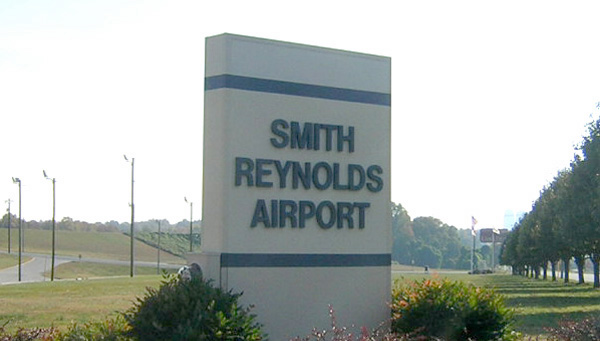
One of the folks in the church Bible study/small group I attend did his initial flight training at Sugar Valley, just like me, got his private pilot’s license and his airframe & powerplant (mechanic’s) rating there too while studying at PBC, but has since gone on to do other things. His name is Jethro, and he’s a mechanic now working both at the Cessna facility in Greensboro and on owner/operators’ planes at Smith Reynolds in Winston-Salem. He flies quite a bit too, working toward his commercial license with hopes of being able to fly people for pay one day and not just work on their aircraft. Very easygoing guy and fun to hang out with. He’s a geek through and through–a plane geek, but a geek nevertheless with an obsession with the latest aviation trinkets and electronic gadgets and a talkative manner–when on the subject of airplanes, that is :) But I’m something of a geek myself so we get on just fine.
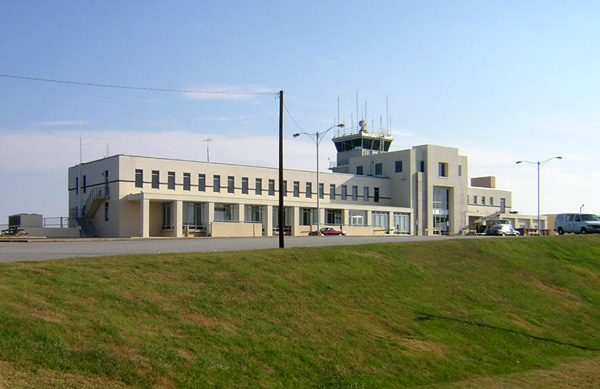
The difference between Sugar Valley and Smith Reynolds: the control tower. It’s what we call Class D airspace. Communications are very different between the two airports, and what to say and do gets a little more complicated when at the larger facility. Instead of just self-announcing intentions and flying right in, you have to contact the tower and they’ll tell you what to do. Traffic management is their job, and a necessary one.
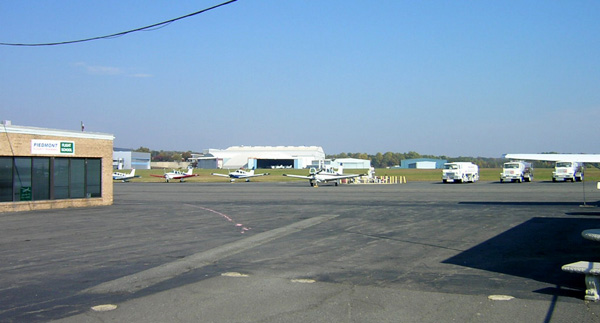
The general aviation (GA) ramp. The flight school/FBO (Fixed Base Operator–an airport service company) building is on the left and you can see the fuel trucks lined up on the right.
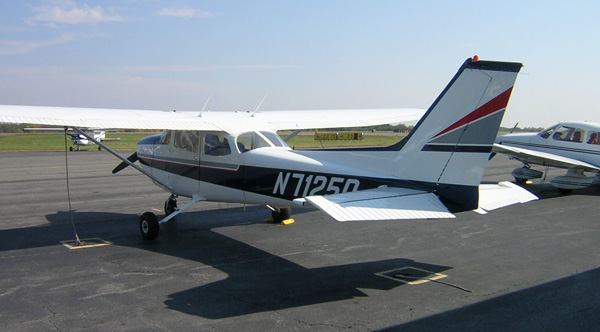
Our little puddle jumper for the day, Skyhawk 7125Q. It’s a Cessna 172, but an older model than the ones we have at Sugar Valley and not maintained quite as well. The instrument layout was surprisingly different but the flying characteristics were similar.
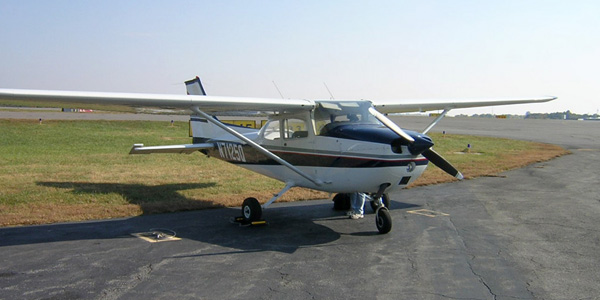
Another shot of “Skyhawk Two Five Quebec.” Jethro’s copying down the tach time.
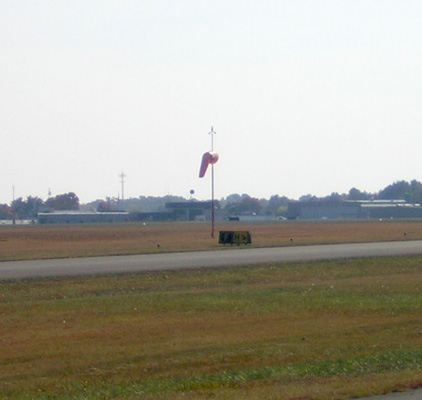
Winds were constant out of the south, so we took off runway 22 (magnetic heading 220°). It was weird being on a runway that wide and not even being able to see the end of it by the time we took off. We flew southwest down I40 through a layer of slight haze to a little grass strip called Hawks Landing. We couldn’t get the owner on the radio so we barnstormed the runway on the first pass just to “wake him up” and let him know we were there. We landed the second time around, turned the plane around and did a soft-field takeoff.
Those are a trip, especially if there are trees at the end of the runway, as there were at Hawks Landing. The whole point of a soft-field takeoff is to get the plane off the ground and out of the grass as soon as possible. The yoke is held all the way back until the plane rises just a few feet off the ground. Then, without climbing any more, but with the nose level and pointed squarely at the trees, the plane accelerates to a speed at which it will climb and not stall out. Then the yoke is pulled back, and the plane finally noses up as a little accumulated airspeed is traded for altitude and it climbs up and over the trees. Fun stuff.
We did a couple of landings at Sugar Valley on the way back. I did the second, and it was a very different experience to be flying the plane from the right seat instead of the left. After that I had the airplane all the way back to Smith Reynolds, with Jethro communicating with the tower and offering advice along the way. I learned a lot and got introduced to a lot of new concepts. I feel like I’m ahead of the game in terms of my flight training.
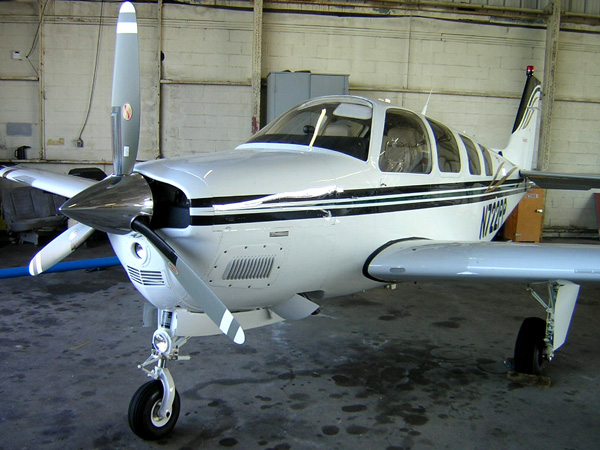
After we landed, more shameless tourism on my part. This is in the FBO’s hangar, a very clean Beechcraft Bonanza.
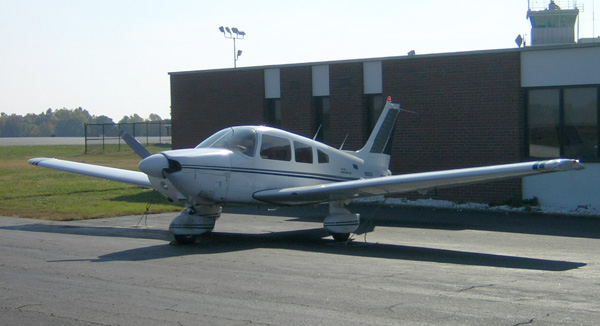
A Piper Archer on the ramp. This is another training airplane. I’ve never flown a low-wing plane before and I’m kind of curious as to how they behave. Not all that differently from the high-wing Cessna’s I’d imagine, but I’d still like to try it.
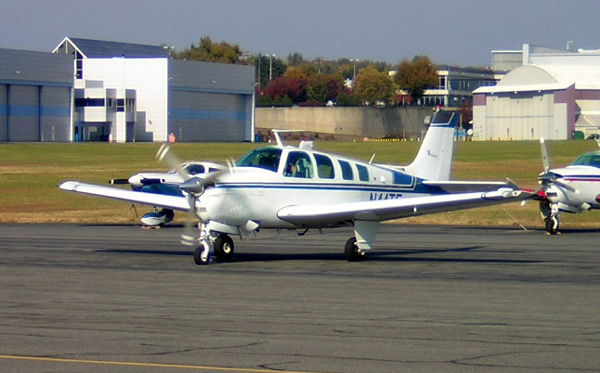
Another Bonanza on the line, getting ready to taxi. These are high-performance airplanes, with retractable gear, variable-pitch props and a whole host of other goodies. They cruise around 220-230 mph–much faster than our Skyhawks, which tool along around 120-130.
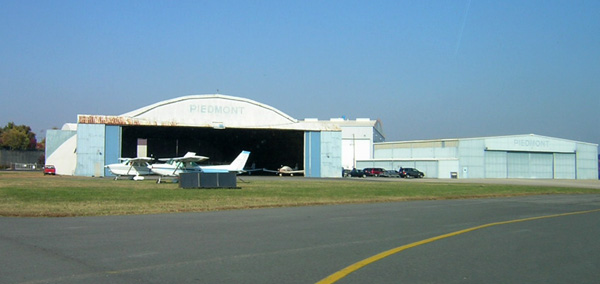
The old Piedmont-Hawthorne hangar. It’s much bigger than it looks in the photo. It’s quite huge. I love the ancient, rusty steel hangar doors that contrast with the sleek, freshly-painted aluminum of the sophisticated airplanes inside.
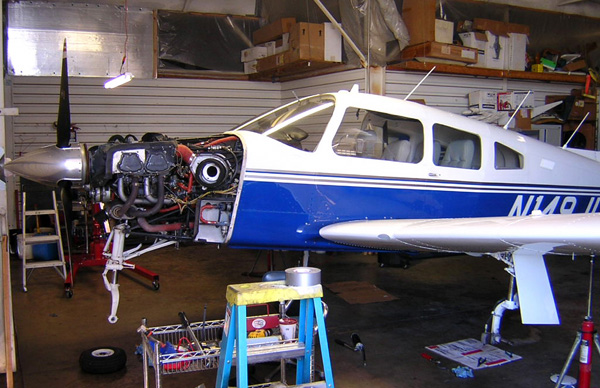
In another hangar, the airplane Jethro’s working on, preparing for a customer. It’s a Piper Arrow, a middle-of-the-range retractable-gear single. The engine’s been upgraded and a nicer prop has been installed, along with a new interior and avionics. I would LOVE to work on this airplane. Or any airplane for that matter. Take the cowling off the engine and I’m salivating, mechanically-speaking, ready to tear into it and fix/upgrade/overhaul whatever needs it.
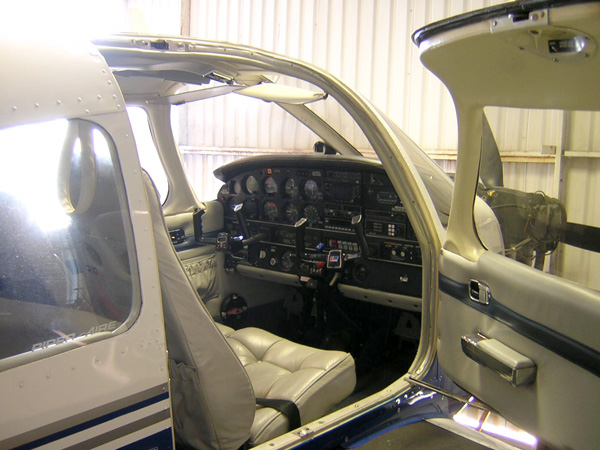
One of the newest GPS systems on the panel inside the all-leather interior. Sexy, sexy airplane.
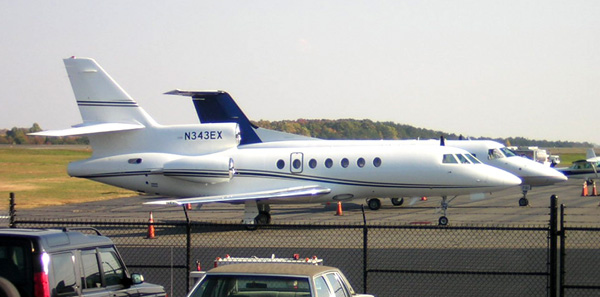
Speaking of sexy airplanes… There were several business jets parked near the end of the GA ramp, and I took this picture of a Dassault Falcon 50 (French airplane, oh yeah) as I drove back by the airport after Jethro and I had lunch at Wendy’s.
Have I mentioned how much I love this weekend? And it’s only Saturday afternoon. Thank you God for most this amazing day…
Still lol-ing about you and sexy airplanes.
How does one salivate mechanically?
By ringing a bell, obviously… sup Pavlov reference.
:)
*groans*
:)
So are French airplanes sexier than most other airplanes? What is the sexiest airplane?
You’re really fixated on this concept, aren’t you? :)
Actually, yes, French airplanes do tend to be sexier than other countries’. Which isn’t to say they haven’t had their share of decidedly unsexy aircraft, e.g. the Farman Jabiru:
But on average, for whatever reason, their airplanes are sexier. A couple of examples:
The Dassault Mirage 2000C, a very hot-looking little fighter jet:
And of course Concorde, which technically is half-French and half-British, but it still counts:
What? I find that first one really, really sexy.