BoldUlysses.comBoldUlysses

Posts filed under ‘Supra’

on the benefits of having the right tool

August 11, 2004

Spent 15 straight hours on Saturday putting an engine into a car, a ’90 Supra, to be precise.

It’s all part of a deal I arranged late last year in order to get a 1JZ-GTE into my ’88. See, the car I was pulling the 1JZ from had already had the conversion done, but I wanted the engine in my car, so I pulled it and installed it in mine with the understanding that I would drop an engine into the donor vehicle and restore it to saleable status. Lesson no.1: When conducting a transaction that involves labor as part of the deal, be very, very sure of what you’re getting into. I won’t say that cash is always preferable, but in my case at least, I tend to bite off more than I can chew with these deals.

Of course, it wasn’t just the engine that needed to go into the ’90. One of the tie rods was bent, so I swapped steering racks and wheel hubs (easier than popping off the steering knuckle ball joint, trust me). The subframe needed a little prepping, and the engine to go in itself was basically a bare long block, and needed to be dressed and bolted to its transmission before installation. This was the part that I thought was going to be much easier than it actually turned out to be.

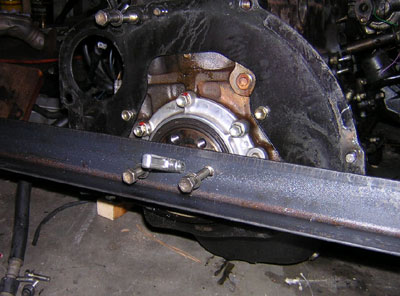
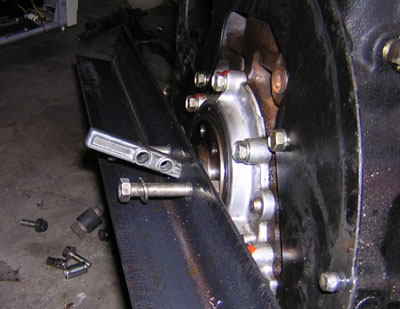
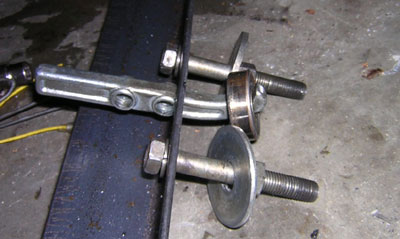
I had a spare engine and transmission lying in my garage that would serve as the donor for the needed parts on the long block to go into the ’90. This is where the first major snag came up. The long block didn’t have a pilot bearing for the transmission input shaft, and I didn’t have a pilot bearing puller for the necessary part off the donor engine. After some scrounging around, halfhearted attempt at careful prying, head scratching, and many minutes spent just staring at the rear main seal area and stewing in frustration, it was decided to just cook up a makeshift puller. Took a piece of angle iron, fired up the drill press, found a pair of suitable bolts and one arm off a small puller, and tried out the solution. After a few minutes of wrench turning, the pilot bearing popped out. I don’t have many success stories to tell involving fabrication, so I figured I’d share this one. Picture 1 2 3

The second major snag occurred when I realized I didn’t have a clutch alignment tool either. This was a bit more straightforward and didn’t involve any fabrication, just a lot of elbow grease. Installed the clutch disk and pressure plate, but only barely tightened two bolts opposite one another on either side of the pressure plate, allowing the clutch disk to slide around somewhat. Lifted the tranny, and after several attempts, finally got the thing to slide all the way on and touch the bellhousing to the block. This step completed, my assistant and I (Joel, who was with me the whole time–kudos) slid the tranny off very quickly and carefully, and tightened down the rest of the bellhousing bolts.

So we got it all done and the engine in. About halfway through the experience Joel remarked that I was a very goal-oriented person (as opposed to someone who just gives themselves a time limit for how long they’re work on something), and I couldn’t help but agree, since my one goal was to get that engine in the car, no matter how long it took that day. But through the course of those two experiences (and several others which aren’t coming to mind at the moment), we probably squandered several hours and a lot of patience… Next time I’ll be sure to have everything I need. The right tools are good for the temper, the time, and the knuckles.

Had any experiences involving the absence of the right tool?
Originally posted here.

on seeing the light

March 16, 2004

Had an (all too rare) moment of insight last night while working on the Supra.

Replaced the water pump yesterday. This is one of the (few) aspects of Toyota engineering I’m not too fond of, and I’m sure they had their reasons, but in order to replace the water pump on a JZ-series engine, the front pulley, timing belt, and even the timing belt tensioner must be removed–the pump just tucks in behind everything on the front of the engine. So last night I was bolting everything back together, and the time came to torque the main pulley bolt something fierce–the spec is somewhere around 175 ft-lbs. I have my trusty 1/2 in. drive torque wrench for this and other suspension-related fasteners, but the trick as far as the front pulley is blocking the engine in order to be able to torque the bolt down. In most cases I would just remove the starter and wedge a hefty screwdriver in the flywheel teeth, but in this case the starter was inaccessible. The car is awaiting installation of the diff (4.10 Torsen LSD–yay), so the driveshaft is hanging free, and I decided to block the driveshaft yoke against the underside of the car to prevent it from turning. Problem was, every time I tried to put any sort of torque on the front bolt, the bar blocking the driveshaft would work its way loose. I had the car in first gear, and then it occured to me–the torque I put on the pulley bolt is being multiplied through the tranny, causing substantially more force on the driveshaft block than I’m applying. So I hopped in, put the car in fifth so there would be a torque reduction through the tranny (overdrive), and clicked the bolt down to 175 ft-lbs without breaking a sweat.

Finished rewiring the harness (again). Should start this afternoon if all goes well. Wish me luck.

Originally posted here.

current state of affairs

December 30, 2003

Getting extraordinarily frustrated with the car. About a month ago I pulled the engine harness off the car and rewired the ECU side of it, getting rid of all the splices and generally cleaning things up pretty well.

Got everything reattached last night, and the car persists in doing the same thing it had before the rewire: Starting strong, revving to ~1500 rpm for a second or two, then completely dying. Every possible course of investigation into the causes of this has been pursued–sensors, wiring, ECU, connectors… Everything.

I know it’s going to be something simple. It can’t be complicated and not change at all as I plug and unplug various peripherals searching for the culprit.

It had been be worth it to drive; that’s all I have to say.

I’m not as bummed out as you might imagine, though. If nothing else I was encouraged by the fact that I ripped the whole harness off the car, rewired and cleaned up every wire leading to the ECU, and I didn’t screw up the car more than it was before. This is good.

I hooked the battery charger up to it earlier and sat in the driver’s seat, listening to the stereo and shifting aimlessly, left hand holding the steering wheel. Between bouts of frustration with the harness, I needed some re-motivation.

Random pictures:

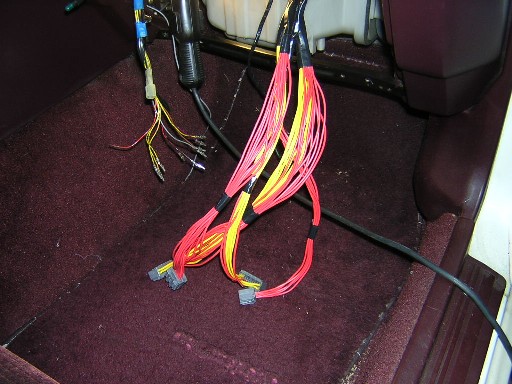
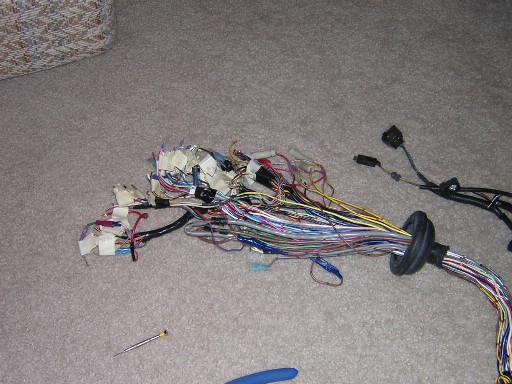
The mass of splices on the ECU side of the harness, pre-rewiring.

The cleaned-up and lengthened harness, all soldered and buttoned up.

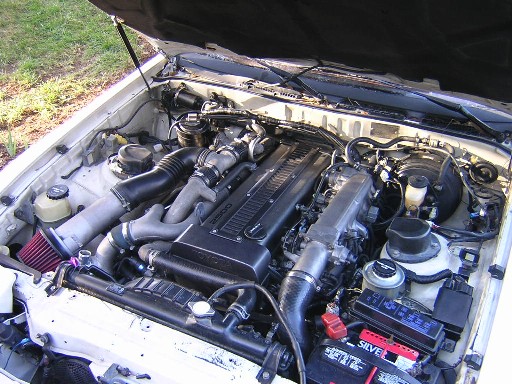
1JZ-GTE. Stock a 280 hp mill, assuming I have decent compression from the ~25K mi. engine (and happy turbos), with the 3″ exhaust, intake, and boost bumped up to 10 psi, I should be over 300 comfortably. For a while. Assuming I get this running by February (please God), I’ll have some hard numbers after a dyno day.

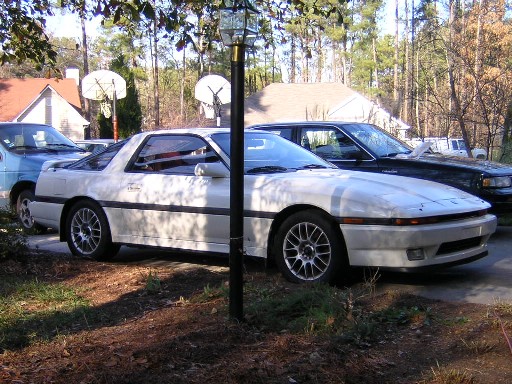
Poor man’s BMW 850i. Apologies for the lamppost in the middle of the photo. The rims are loaners–they’re from the engine’s donor car and the owner of said car wants them back. I couldn’t resist putting them on, though. They’re only 16×7 (stock size), but it’s definitely the style I want, albeit much larger (18×9-10). All in good time. I just want to drive it… Wish me luck.

Update 12/30/03: It RUNS! Thanks for all the help, guys. It wasn’t getting fuel, as most of you suspected. After poking around for a little bit I did the one thing I hadn’t done yesterday that I knew to do–jumpered the fuel pump from the diagnostic block on the harness. It fired right up and didn’t die! There are still a few more quirks to work out, but this is HUGE, and I’m elated.

Originally posted here.

engine swap update

November 28, 2003

I had gotten everything hooked up, and after splicing about 25 wires last Wednesday and spending almost all of my free time the rest of the week and Saturday debugging the TPS and MAP sensor wiring, I got the car to a point where it would start, rev to 1500 for a few seconds, then die, without my touching anything. If I tried to keep it alive with the throttle, it would just die all the more quickly. I wired up custom harnesses, bypassing the main harness from the sensors in question to the ECU, to no avail–same deal.

It was clear a couple of days ago that the harness on the car, pre-extended by a gentleman in California but of questionable quality, had a short or a crossed wire somewhere in the loom, not to mention the glove box area was a rat’s nest of splices. I had visions of wrestling with the harness for a few more days, getting the car running for another week, then getting inexplicable electrical issues that put the car out of commission for months or worse, damaging the engine. I did not want this. I had spent about 30-35 hours on the car in the past week and was getting extraordinarily frustrated at its lack of cooperation. I had a couple of options:

1. Go standalone. MoTeC makes aftermarket ECUs that would adapt to the 1JZ, and the Haltech E11 will actually even use the stock Toyota coils, ignitor, CPS, and include a base fuel map, enough to get me to the dyno so I could work the rest of the fuel and ignition curves out. The processors inside either unit are light-years ahead of the ~1990 programming in the factory ECU. Going standalone is arguably the acme of my tuning goals–it’s something I’ve always wanted to do.

2. Pull the existing harness completely off the car and rewire everything from sensor to ECU, doing it right, no splicing, but solid wires, shielded where necessary, soldered, heat-shrunk, and zip-tied. This has the advantage of being free, minus the wires and such, and I have wiring diagrams and pinouts already for the ECU. It also doesn’t require any tuning after the fact. Double/triple check everything, hook up connectors, and turn the key. Hopefully.

3. Triple blow-through Webers, a la early Esprit Turbo. Just kidding.

So it looks like no.2 is the way I’m going. I don’t want to have to take off the upper intake manifold but it looks like I’m going to have to.

On the plus side, I’ve gotten a set of mk4 550cc injectors (straight drop-in w/resistor pack) and mk3 Supra-specific coilovers for really cheap. The shocks are gone on them, but hopefully that should be a simple matter of finding replacement cartridges. Also, for the little time the engine was alive, the car sounded beautiful, what with the 3″ HKS downpipe and GReddy catback. Very deep and powerful–nothing raspy or tinny about it at all.

Originally posted here.

automotive musings

November 21, 2003

How can a sports car driver ever be happy with their car?

Sports cars, by and large, are about speed. Speed in the twisties, or speed down the strip on a Saturday night, even speed to a halt (braking). But here’s the thing many of us realize, especially after embarking on our car’s modification program: There will always be someone faster than you. There will always be cars that cling to the corners more tenaciously, are more direct in their responses, and hook up better off the line. How does one reach automotive contentment, then? How can you be really happy with your car when you’re annihilated at a stoplight race or humiliated around the road course? Can you be?

The key I think is to own a car that is special to you for reasons unrelated to pure speed. A car that agrees with you. A car that feels like home when you sit in it and lets you breathe more deeply when you sink into the seat after a hard day at work. A car that makes you smile just tooling around town at 25 mph. A car that is your car.

I used to ponder the owner loyalty of cars I was familiar with–the FB, the Z-car, FD, the mk4 Supra, etc… and why for example many, many first-gen RX-7 owners will hang onto their cars through thick and thin, whereas more than a few mk4 drivers go through a couple of cars in a year–and I think there’s more at work than simply the financial ability to buy and sell cars frequently. For a lot of owners there’s something the FB has that the mk4 doesn’t (and vice-versa of course), counterintuitive to many of us who are acquainted with the latter car’s prowess, and I think those subtler qualities are lost on a lot of the performance-fixated automotive community.

We’re all addicted to speed, sure, but that intangible special quality of a car we’re really attached to is beneficial in more than one way, I think. It’s that knowledge, that feeling, that promotes a sense of contentment when we’re approached a light and revved on and we decline to go, just knowing that we don’t have anything to prove. It’s that knowledge that makes us humble about our cars, and fosters an atmosphere in which we can genuinely appreciate others’ cars without getting defensive. We see our car’s flaws, to be sure, but somehow they’re okay; they’re inconveniences cheerfully borne.

And that’s what made me keep the Supra. With the addition of a few mods, I felt myself getting caught up in the Great Speed Race, uncomfortably so, and wanted an “out,” another car where it might be easier to sense its other endearing qualities upon an initial drive, and I immediately gravitated towards my first automotive love (the FB). But then I realized I could have that with the Supra too. All I had to do was to re-experience what made the car special to me. It just took a moment.

It was a cold night when I slipped into the perfectly contoured seat, surveyed the dash, with all the controls and switches ideally placed. I turned the key, the car started with an elastic smoothness and settled down to a rock-solid 700 rpm idle. I flipped the lights on; the headlights popped up and the gorgeous analog gauges were lit up with a pleasingly pale green. I gripped the thick steering wheel and rested my hand on the shifter. Everything felt substantial, solid. The car just fit me. I thought about the way the car looked and the image that projected–not the flashiest, most curvaceous body style, but understated, well-proportioned, and attractive–and I thought about my own self-image. My impression of the car and my concept of what I wanted to project lined up perfectly. It agreed with me; it was home–and I wasn’t even moving. After that moment even the metallic rip of the inline-six up to redline and the whistle of the turbo on the way home were just fluff–the car and I shared a bond deeper than raw speed, and any thoughts of parting with it were pushed from my mind.

What makes your car your car?

Originally posted here.